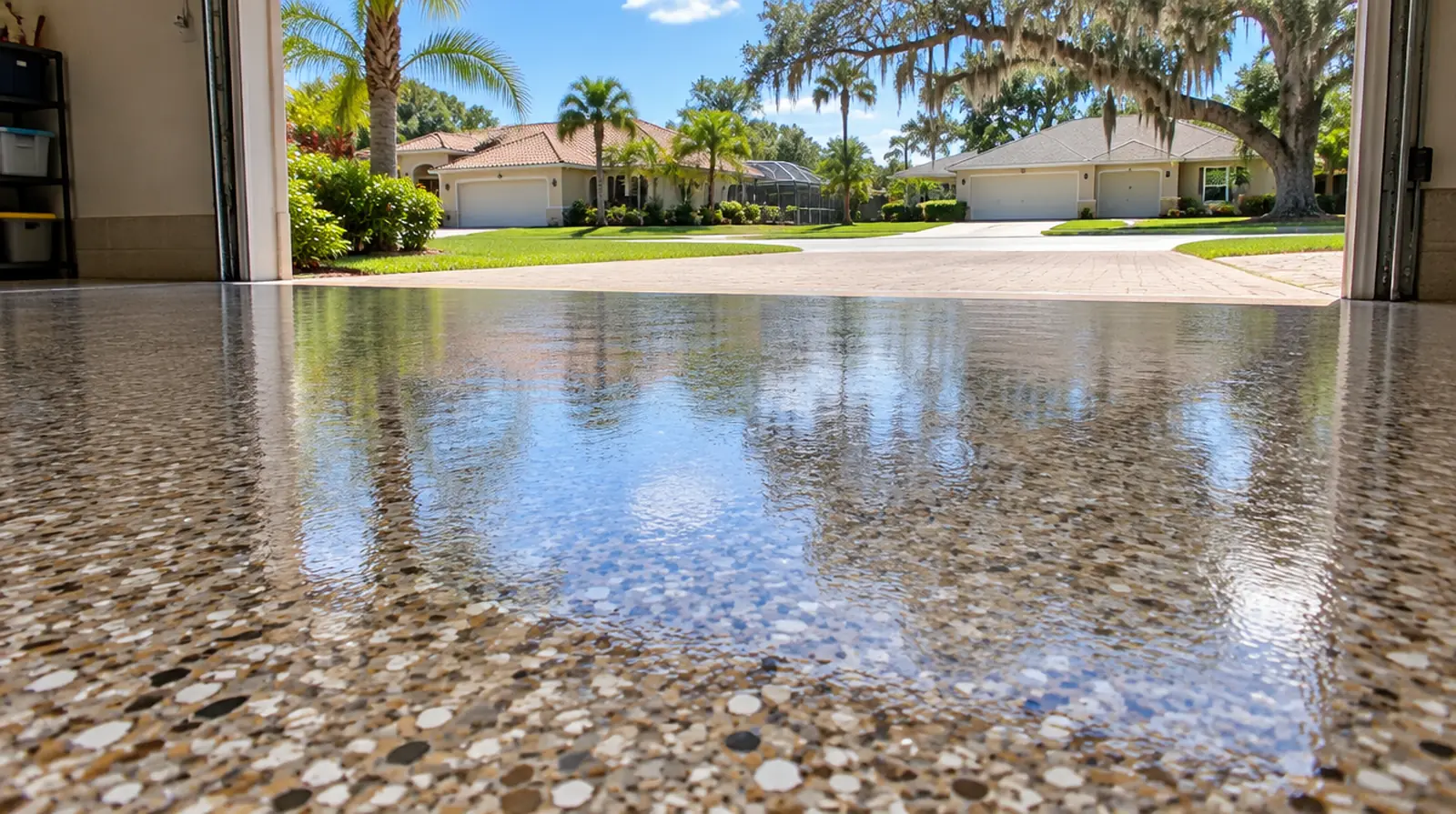
Why flake works so well here
Sand is a fact of life in Central Florida. It comes in on shoes, bikes, beach chairs, pool toys and dog paws. On a solid-color floor, every grain shows. A flake floor has a multicolored, speckled surface that disguises sand, dust and small debris between cleanings. The texture from the flakes also adds grip, which matters when someone walks in dripping from the pool or a summer downpour. For busy households, flake is often the most practical choice.
How a flake system is built
We start with the same preparation as any of our floors: full diamond grinding with dust collection, crack and divot repair and moisture testing. Then we apply a base coat tinted to complement the flake blend. While it is still wet, we broadcast vinyl flakes by hand until the floor is fully covered, so no base color shows through. After the base cures, we scrape and vacuum off loose flakes, leaving a uniform, textured surface. Finally, we seal it with one or two clear topcoats.
Full broadcast versus partial
In a full broadcast, flakes cover the entire surface. This gives the most texture, the strongest hiding power and the most durable result. A partial broadcast scatters fewer flakes over a solid base for a lighter, more modern look. We usually recommend full broadcast for garages and partial for interior spaces like laundry rooms or offices.
Choosing a topcoat
The topcoat locks in the flakes and determines how the floor feels. A polyaspartic topcoat is our standard for Florida because it will not yellow when the door is open and the sun hits the floor. We can adjust the texture: a smoother topcoat is easier to clean, while a slightly rougher finish gives more traction.
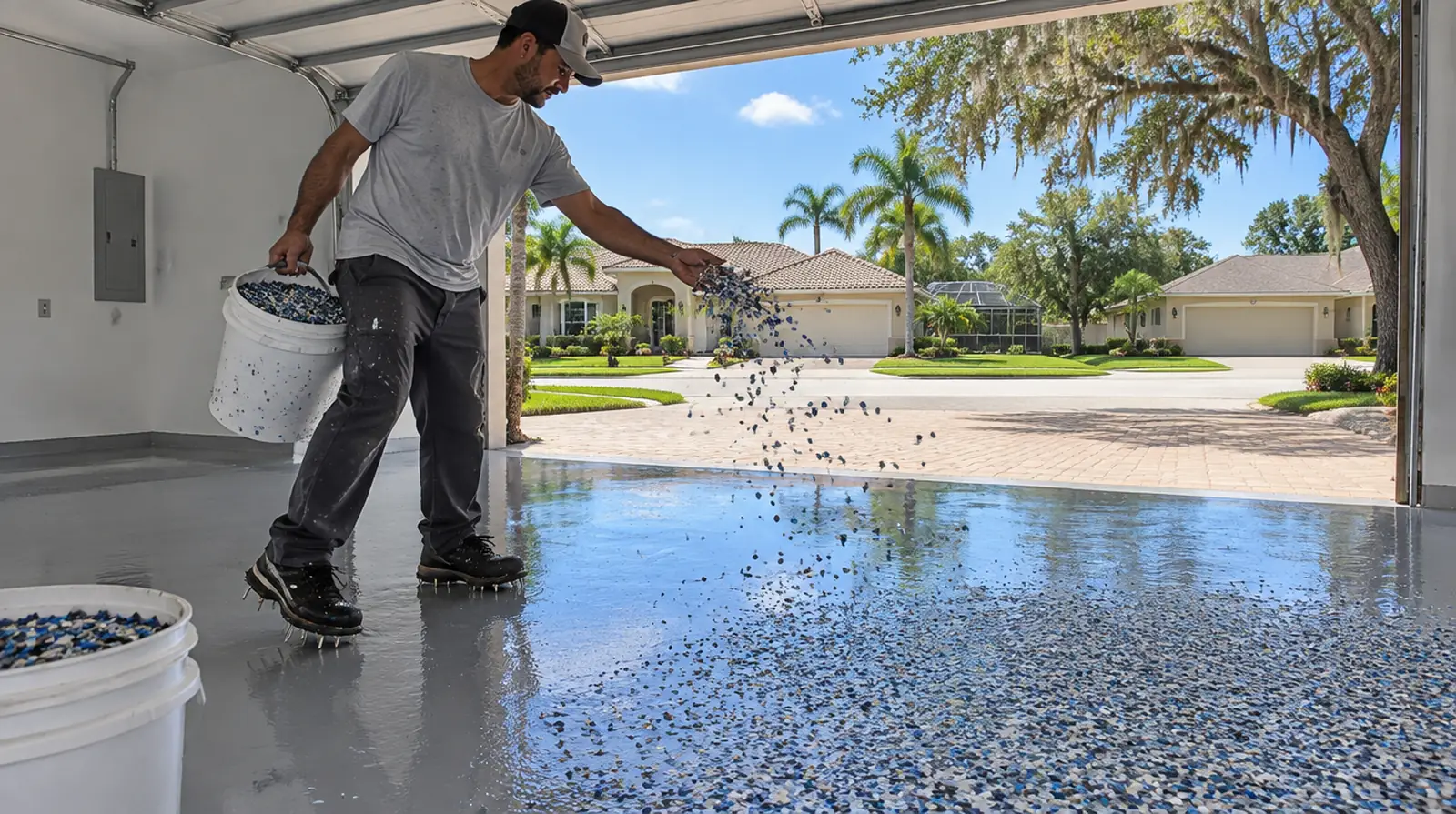
Popular color blends
Earth tones like tan, brown and gray pair nicely with typical stucco homes. Cooler blends of gray, black and white feel modern and clean. Some homeowners choose blends that echo coastal colors with soft blues and sand tones. We bring a sample board to the estimate so you can see each blend in your own garage light.
Beyond the garage
Flake systems also work on screened lanais, covered patios, laundry rooms, mudrooms, workshops and commercial back rooms. Outdoors and under screen enclosures, we always use a UV-stable topcoat and a texture suited to bare feet and wet conditions.
Durability
A full flake floor is thick and resilient. Small impacts from dropped tools rarely show, and if a spot is ever damaged, it can be patched and recoated with less visible difference than a solid-color floor. The topcoat can be refreshed after years of use to restore the gloss.
Cleaning
Sweep or dust mop regularly. For deeper cleaning, use a soft-bristle deck brush with a mild cleaner and rinse. Avoid harsh acids or solvents. That is all it takes.
Questions
Is a flake floor slippery when wet?
A full broadcast floor has natural texture, and we can add anti-slip grit to the topcoat for extra grip.
How long does it take?
Most garages take one to two days. Polyaspartic systems can often be done in a single day.
Can I see a finished floor?
We are happy to share photos of past projects and sample boards during your estimate.
Get your flake floor estimate
Contact us to set up a visit, or compare with solid-color garage epoxy.
Ask about matching stair treads or a garage step for a finished look.
Get a flake floor quote
Call (407) 890-7970 for a free estimate.